
Safe Medication Management at Home
Safe Medication Management at Home
When a family member takes several medications every day, daily care can become more complicated than it first appears. Different tablets, different times, instructions to take with or without food - all of these increase the chance of a mistake. Managing medication safely at home does not require medical knowledge, but it does require organization, attention, and the right support when needed.
In this article we explain the risks of polypharmacy, the most common errors that happen at home, and practical ways to avoid them - always in coordination with your treating physician.
What Polypharmacy Is and Why It Needs Attention
Polypharmacy refers to taking several medications at the same time, something especially common among older adults or people with chronic conditions. The more medications involved, the greater the chance of:
- Interactions between drugs, which may reduce their effect or intensify side effects
- Confusion over timing, especially when some are taken in the morning, others at midday, and others at night
- Food interactions, since some medications are absorbed better on an empty stomach and others with food
- Overlap, when two medications have a similar effect
Polypharmacy is not bad in itself - it is often necessary. The goal is for it to be managed safely and under supervision.
Common Errors at Home
Most medication errors at home are not due to carelessness, but to fatigue and complexity. The most common are:
- Missing or doubling a dose when there is no clear tracking system
- Wrong timing, which can affect how well the treatment works
- Confusing medications with similar names or appearance
- Stopping a medication without consulting the physician because the patient “feels better”
- Taking expired medications or storing them poorly (for example, in a damp or hot place)
- Taking supplements alongside prescriptions without telling the physician
Important: never change the dose or schedule of a treatment on your own. Any change must be made by the treating physician.
Practical Organization That Reduces Errors
A little organization makes an enormous difference. Try the following:
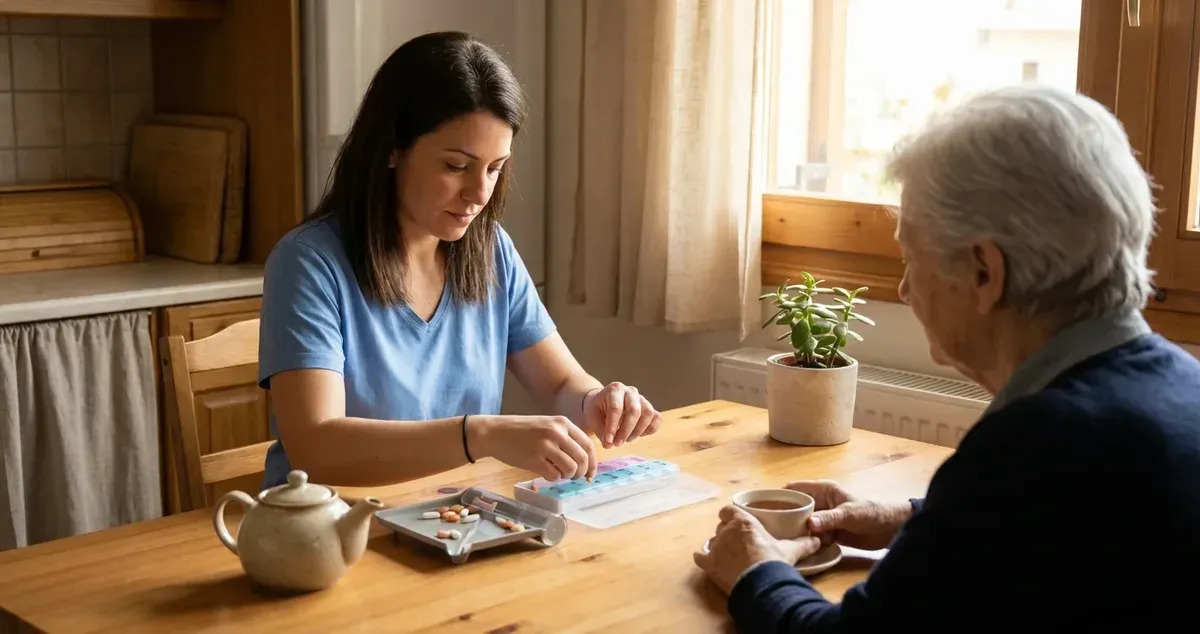
- A weekly pill dispenser with compartments by day and time. Fill it once a week, calmly and without distractions.
- A clear schedule on paper or on the fridge, showing what is taken and when.
- Reminders through an alarm clock or phone for dosing times.
- An up-to-date medication list with the name of each product, its form, frequency, and the reason for use. Always carry it to every visit to a doctor or hospital.
- Stock checks so a medication does not run out unexpectedly.
The up-to-date medication list is perhaps the most valuable tool: it helps every health professional get a full picture and reduces the risk of interactions.
The Role of the Nurse
In complex cases, support from a specialized nurse offers reassurance to both the patient and the family. A nurse can:
- Safely administer medications that require technical knowledge, such as injectables or treatments through a catheter
- Organize the schedule and prepare the weekly pill dispenser
- Monitor the response to treatment and any side effects, alerting the physician promptly
- Educate the family in safe practices
- Coordinate with the treating physician and the pharmacy
The nurse does not replace the physician; the nurse acts as a link who ensures the treatment is applied correctly and monitored consistently at home.
Coordinating with Physician and Pharmacy
Safe medication is a team effort. Ask the physician for a periodic review of all medications, especially after a hospital stay or a new diagnosis. Your pharmacist can identify possible interactions and explain the correct way to take each medication. Always mention every drug, supplement, or herbal product being taken.
Tips for Families
- Designate one person as the main person responsible for the medication, to avoid double dosing.
- Keep medications in a safe, cool, dry place, away from children.
- Note any new symptoms and report them to the physician.
- Do not hesitate to ask - no question about medication is too small.
Safe medication management protects health and brings peace of mind to the whole family. If you feel the treatment has become complicated, or something is worrying you, do not stay in doubt. Contact us to Request a Nurse Visit - we will help you organize the treatment safely, in close cooperation with your treating physician.